Mississippi and What Senate Control Markets Price
Scott Colom says he can flip Mississippi. Here's how a widening Senate map feeds into majority contracts on Polymarket and Kalshi — and where the.

Scott Colom, a district attorney and the Democratic nominee in Mississippi, says he can beat Republican Sen. Cindy Hyde-Smith. “We can win here, and we’re going to,” he told ABC News. Republicans say he has little chance.
The arithmetic behind that argument is unforgiving. According to the ABC News report, Democrats must pick up at least four seats to take the Senate — and more than four if they lose any they currently hold. Michigan is the obvious exposure: Republicans say they feel better about it since progressive Abdul El-Sayed won the Democratic nomination.
Why a long-shot seat still matters to the majority price
A Senate majority contract is not a poll average. It is the market’s estimate of a joint outcome across every contested seat, and joint outcomes are dominated by correlation between races, not by any single one.
If Mississippi becomes genuinely competitive, the useful information is rarely “Democrats gain one seat.” It is that the national environment shifted enough to put a state like Mississippi in play at all — and if that read is right, the same shift is showing up in Iowa, Kansas and Nebraska too. That is the correlation argument, and all it supports is this: a price move in a supposedly safe seat carries more information about the environment than a move in a race already priced near a coin flip, because the coin flip was always going to sit near 50 and tells you little when it wobbles.
The reverse also holds. Maryland Sen. Angela Alsobrooks, campaigning in Mississippi for Colom, put the constraint plainly: “We can’t spare a single seat.” A Democratic loss in Michigan does not subtract one from the count. It raises the required number of pickups to five, and each additional required seat is drawn from a thinner, redder pool.
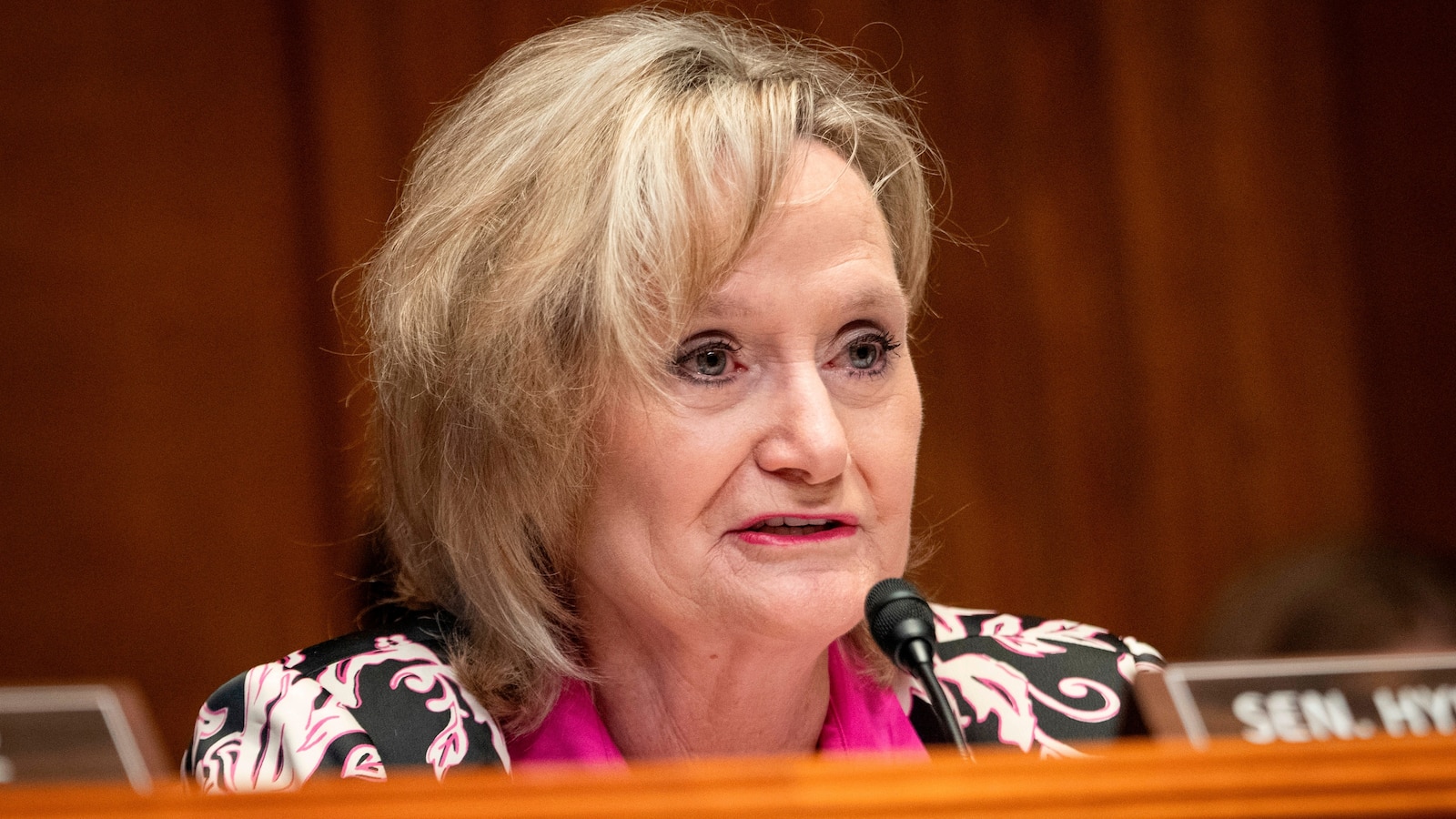 Photo: abc-politics
The four wildcard seats the report flags
| Race | Republican nominee | Democratic (or backed) nominee | Structural note |
|---|---|---|---|
| Mississippi | Cindy Hyde-Smith (incumbent) | Scott Colom | Majority required to win statewide; runoff possible with minor candidates |
| Iowa | Ashley Hinson (Trump-endorsed) | Josh Turek | Open seat — Joni Ernst is not seeking reelection |
| Kansas | Roger Marshall (incumbent) | Adam Hamilton | Marshall’s first reelection bid; state has elected Democratic governors four times since 2002 |
| Nebraska | Pete Ricketts (incumbent) | Dan Osborn (independent) | No Democrat on the ballot; national Democrats back Osborn |
Two of those carry structure that a naive seat-by-seat model misses.
Mississippi requires a majority to win a statewide election. With minor candidates on the ballot, ABC News describes a scenario where Colom either pulls an upset or at least forces a runoff. For a trader, that is two different instruments. Suppose you put the chance of no candidate clearing 50% at 20%, and Colom’s chance of winning a head-to-head runoff at 35%. That branch alone contributes 0.20 × 0.35 = 7% to a “Colom wins the seat” price, before you add the outright first-round win. Our conditional chain probability calculator handles the chaining when there are more than two links.
Nebraska has no Democrat at all. Osborn runs as an independent, which means any Senate-control contract has to specify how an independent’s caucus decision resolves. Read the contract text before assuming it counts toward either side.
What the reporting actually gives you
No results here — this is a map assessment, and map assessments move majority contracts modestly and slowly. The concrete data points: Ernst is not seeking reelection, El-Sayed won the Michigan nomination, Hinson has Trump’s endorsement, and Obama has endorsed Turek — on the basketball court, Turek being a wheelchair basketball star.
Senate Majority Leader John Thune argued in a fundraising email that the widened map cuts the other way: “By scrambling the Democrats, we’ll spread their resources thin, making it nearly impossible for them to flip the seats they need to take the majority.” That is a fundraising claim, not evidence, but it points at a real mechanism. Money spent introducing Colom in Mississippi — where television is far cheaper than in a state like Texas, per the report — is money not spent in Michigan.
Colom’s own path, as described in the story, is arithmetic: raise Black turnout in Mississippi by a few percentage points and win a larger share of the white vote than Democrats usually do. The state’s 2023 governor’s race was decided by three points. That is the benchmark to watch, and it is closer than the state’s national reputation implies.
Reading the price if you have not traded one
An event contract resolves at $1 if the stated outcome happens and $0 if it does not. Hypothetically, if a “Democrats win Senate control” contract were quoted at 22 cents, that is the market saying roughly 22% — you risk 22 cents to make 78. No source here supports any particular live price; the number is illustrative.
The subtlety is entirely in the resolution language: which seats count, how an independent is treated, and what happens to settlement timing when a state’s result is delayed. Our field guide to reading Polymarket odds as probabilities covers the conversion. The venues publish per-market rules — Kalshi and Polymarket both attach them to each contract — and that is the part that costs people money.
The trade structure, not the trade
The honest position on Mississippi is that it is cheap optionality on a correlated national shift, not a standalone bet on Colom. If you think the environment described in the reporting — tariffs biting agricultural states, grocery and gas costs — is real, the coherent expression is a basket across the four wildcards rather than a single seat. If you think it is candidate bravado plus a slow news month, the majority contract is the cleaner short.
Position sizing across correlated legs is its own problem; the Kelly calculator assumes independence, so haircut accordingly.
FluxrBot watches these seat-level contracts and flags when one moves without the majority contract following.
Primary source: abc-politics
FAQ
How many seats do Democrats need to take the Senate?
According to ABC News reporting, Democrats must pick up at least four seats. If they lose any seat they currently hold — Michigan is the most cited risk — the required number rises accordingly.
Why would a market care about Mississippi if Republicans are heavy favorites?
Because seat prices are correlated. A safe-state seat becoming competitive is usually evidence about the national environment rather than about that one race, and that environment affects every other contested seat at once.
How does an independent candidate affect Senate control contracts?
Dan Osborn is running as an independent in Nebraska with national Democratic backing. Control contracts must specify how an independent’s caucus choice resolves, so the rules text on the specific market decides whether such a win counts toward a majority.