Iraq Closes Shalamcheh Border Crossing With Iran
Reuters, citing two sources, says Iraq ordered the Shalamcheh crossing with Iran closed. What is confirmed, what is missing, and how traders read it.
Iraq has ordered the closure of the Shalamcheh border crossing with Iran, according to Reuters, which attributes the order to two sources. The report carries no official reason and no end date, and roughly 38 outlets that have run the story in the last 24 hours — one in the US, 37 internationally, by our headline tracker’s count — have added neither.
That is the whole of what is on the record so far. Everything below separates the confirmed part from the gaps, because in a story this thin the gaps are the tradable information.
Why did Iraq close the Shalamcheh crossing?
No government has said. Reuters’ account rests on two sources who are not named, which is how border stories usually break — a security or provincial official confirms a gate is shut before any ministry issues a statement. Three corroborating items sat behind the Reuters headline in our tracker, but none supplied a reason.
What can be pinned down independently is the place itself. Shalamcheh is an Iraqi border town and crossing point in Basra Governorate, on the Iran–Iraq border — the southern end of a frontier that runs several hundred miles north to the Turkish tripoint. Wikipedia describes the crossing as handling trade and pilgrim traffic between the two countries. Shutting a gate like that is not a costless gesture: the Iraqi side pays for it in freight, in customs revenue and in the queue of traders and travellers turned around.
Photo: Reuters.
What is confirmed, and what is still missing
| Item | Status in the first 24 hours |
|---|---|
| The closure order itself | Reported by Reuters, citing two unnamed sources |
| Official reason | Not published |
| Duration or end date | Not published |
| Status of other Iran-facing crossings | Not published |
| Any Iranian response | Not published |
Two of those rows matter more than the rest. A single crossing closed for security reasons is a government managing a risk it does not want. Every Iran-facing crossing closed in the same week is something else entirely.
A closed gate is a different kind of signal than a speech
A threatening statement costs a government nothing. A border closure costs money, angers merchants and is visible to everyone from truck drivers to Tehran. When a state takes that step it generally believes movement across the line is something it can no longer control — fighters, displaced families, smuggling, retaliation — and has decided to stop it pre-emptively. That is why escalation traders weight physical, hard-to-reverse moves above rhetoric.
The same logic has a limit, and it is timing. By the time a gate shuts, the decision to shut it was made days earlier in a room nobody was watching. Price usually learns first. When we covered the Saudi pipeline shutdown after a drone attack traced to Iraq, the energy market had already repositioned; the physical damage was the confirmation, not the news. A border closure is the same species of lagging evidence — useful for direction, late for entry.
What this does to an escalation contract
The source material carries no live prices, so any number quoted here would be invented, and we do not invent numbers. The mechanic, for readers who have never held one of these: an escalation market is a plain yes/no contract. You buy a “Yes” share for, say, 34 cents; if the named event happens by the deadline it pays $1, and if it does not it pays nothing. The price is the crowd’s probability, so 34 cents reads as roughly one chance in three — our odds converter does the translation in both directions. After a headline the useful figure is not the level but the move: did Shalamcheh push a Gulf escalation contract up two cents or eight, relative to the last five Gulf headlines? Two cents is noise. Eight is a desk revising.
The other thing that decides whether this headline can pay anything is wording. Our piece on what Gulf escalation contracts actually resolve on makes the point that most of these markets settle on a named military action, not on a border measure. A crossing shutting does not resolve a strike contract. A trader who bought on this headline alone is holding a position that this news cannot cash.
What to watch next
- An Iraqi government statement naming a reason and an end date.
- Whether the other Iran-facing crossings stay open. This is the single cleanest read on severity.
- Any Iranian response, including reciprocal closures.
- Oil and freight rates, which move faster and louder than the politics.
- Whether officials describe the measure as temporary security handling or indefinite.
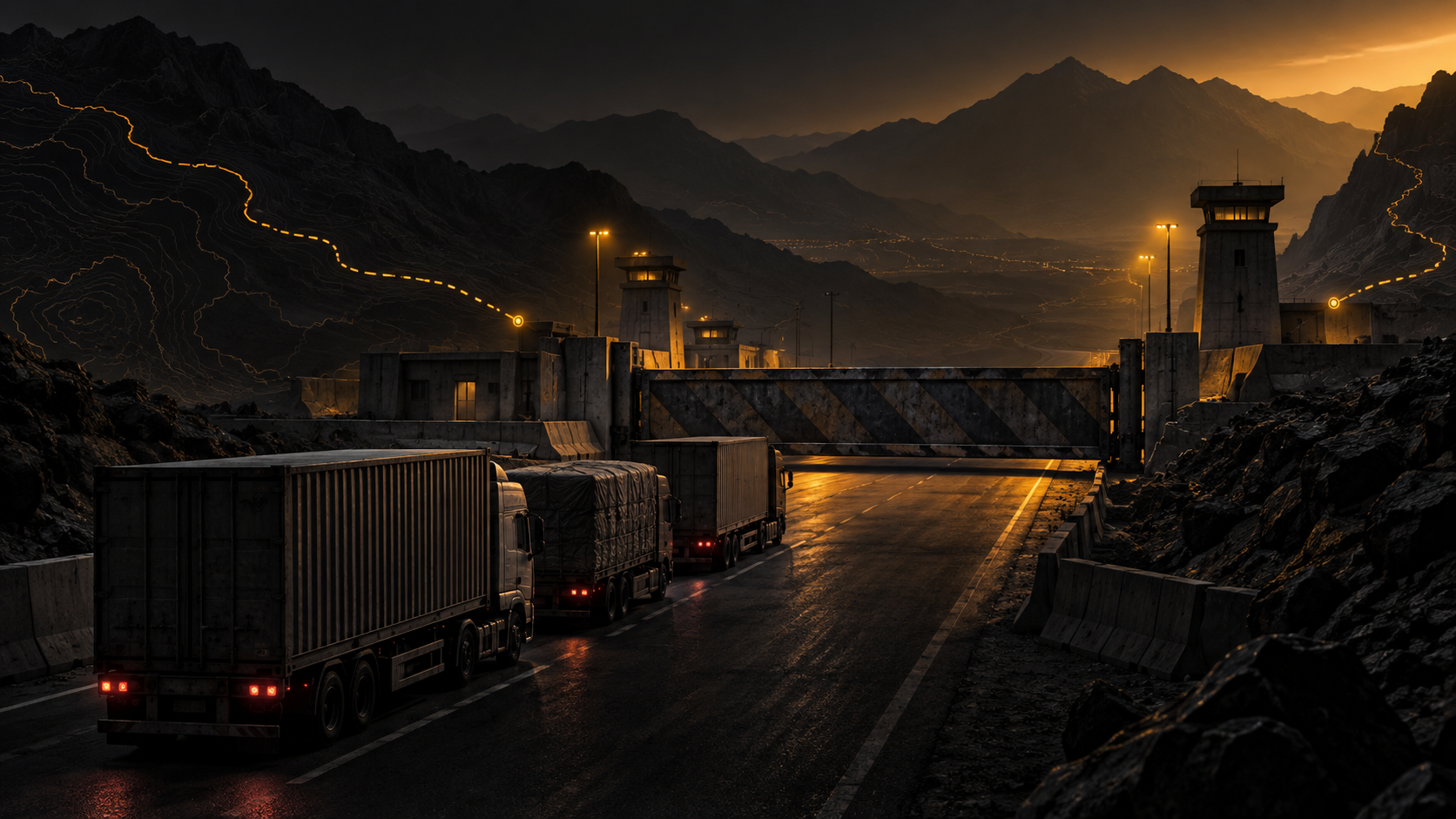 Photo: FluxrBot illustration
Illustration: FluxrBot.
Photo: FluxrBot illustration
Illustration: FluxrBot.
The first hours of a border story are mostly holes. The holes fill fast, and the traders who wait for them generally get a better price than the ones who guess at the shape.
Primary source: Reuters
FAQ
Why did Iraq close the Shalamcheh border crossing with Iran?
No government has given a reason. Reuters reported the closure order citing two unnamed sources, and the follow-on coverage in the first 24 hours did not add an official explanation or an end date.
Where is the Shalamcheh crossing?
It is on the Iran-Iraq border in Basra Governorate, in southern Iraq. Wikipedia describes it as a crossing point handling trade and pilgrim traffic between the two countries.
Does a border closure mean the conflict is spreading?
Not on its own. One gate shut is consistent with a government managing a risk it does not want. It becomes a stronger signal if other Iran-facing crossings follow, if Tehran responds in kind, or if it lines up with visible military movement.
Can I trade this headline on a prediction market?
Most Gulf escalation contracts settle on a named military action rather than a border measure, so a crossing closure may not resolve any of them. Check the resolution wording before buying, and watch the size of the price move rather than the price level.