AfD Protests in Germany: Tens of Thousands March
France24 reports tens of thousands marched against the AfD in Germany. What a crowd count does — and does not — do to German election market prices.
Tens of thousands of people protested in Germany against the far-right Alternative für Deutschland, France24 reported on 12 September 2026. This piece sticks to what that report establishes, and to the narrower question a trader would actually ask: does a march of that size change the price of a German election contract.
What the report establishes — and what it does not
The verified spine is thin, and it is better to say so than to pad it. One international outlet, France24, described turnout across Germany in the tens of thousands and identified the AfD as the target. The date above is taken from the publication URL. That is the extent of what can be attributed here.
What is not established in the material available: city-by-city counts, the names of the organisers, whether the figure is a police estimate or an organiser’s claim, and any polling consequence. German protest numbers routinely arrive from two directions — organisers and police — and the two are rarely close. A national “tens of thousands” also usually aggregates several cities on one day, which makes it a measure of mobilisation capacity rather than of any single crowd.
Treat the number as reported, not audited.
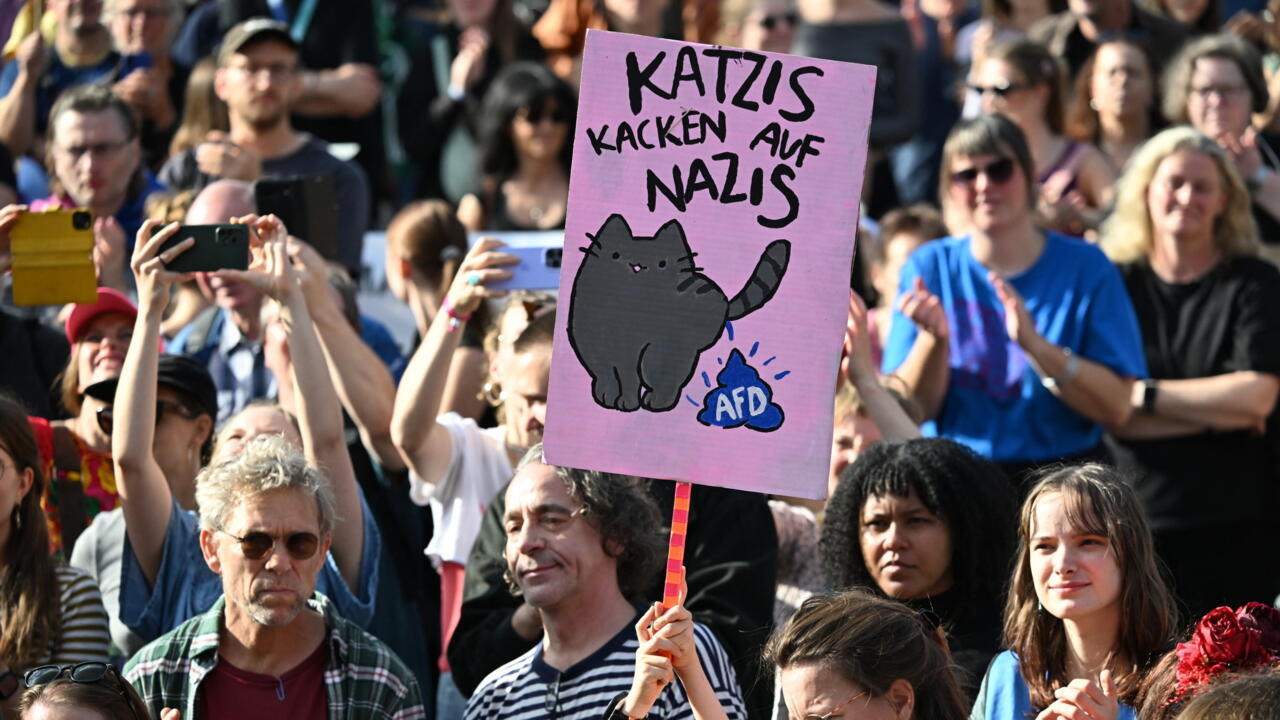 Photo: France 24
Why a crowd count is a weak input
An anti-party demonstration measures the intensity of a party’s opponents. It does not measure the size of that party’s support, and the two can move together, apart, or in opposite directions — a large march is often a reaction to a party polling well. For a market, the question is never “how many people marched” but “did anything change about the probability of the outcome the contract settles on.” A protest that produces no new polling, no defections, no coalition repositioning and no legal filing leaves every one of those probabilities where it was.
What does move a German election contract
| Signal | Typical effect on price | Why |
|---|---|---|
| Street turnout | Minimal | Opponents’ intensity, not vote share |
| Poll averages | Large, and dated | Direct input to expected seat shares |
| State election results | Large | Real votes, settled, turnout included |
| Coalition statements | Large | Decides whether a plurality becomes government |
| Party funding | Moderate | Hard numbers that reveal durability |
| Court or institutional action | Severe and abrupt | A discrete event a contract can settle on |
The last row is the one that gets mispriced, because it is easy to forget it exists. Germany’s constitution provides a procedure under which the Federal Constitutional Court can prohibit a party found to be seeking to undermine the free democratic basic order. It runs through formal filings and hearings, each of them datable, and the court publishes its procedural rules on its own site. Nothing in the France24 report indicates such a proceeding is under way; traders hold it as a tail risk, not a base case. For background on the party itself, the AfD’s Wikipedia entry covers its history and platform.
If you have never traded one of these
Most political markets are binary: a share pays $1 if the outcome happens and $0 if it does not. Consider a hypothetical share trading at 34 cents — that price implies roughly a 34% chance, and you can run the conversion both ways with our odds converter. Prices are set by buyers and sellers rather than by a model, which is why thin boards twitch. Non-US election contracts are usually far less liquid than American ones, so a handful of large orders can move a price with no news behind it. Our five-minute field guide to reading odds as probabilities walks through the mechanics.
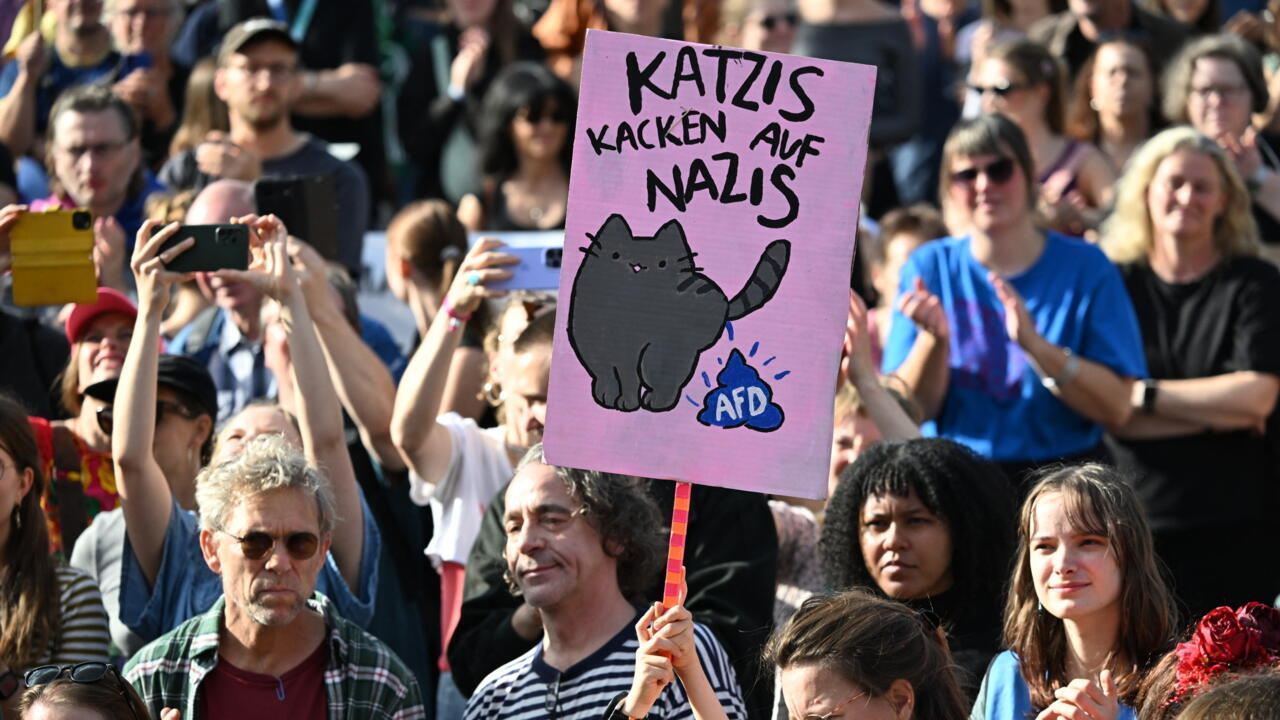 Photo: France 24
What to watch after the marches
The France24 report carries no market data, and there is no reason to expect a crowd count to show up in a quote. The follow-on signals are duller and more useful: whether national polling shifts in the weeks after the demonstrations, whether the AfD’s state-level results hold, and whether other parties restate or soften their refusal to cooperate with it.
Organisational signals are worth watching precisely because they are quantifiable in a way crowds are not. Britain’s Reform UK has now landed a second record £36 million donation — a number that says something durable about a party’s trajectory. A protest photograph does not.
The honest scope
One wire report establishes that large demonstrations against the AfD took place in Germany and were covered internationally on 12 September 2026. It does not establish who organised them, how many people were in any given square, or what happens next. The methodological point survives the gaps: in European politics, the events that reprice election markets almost always have a number attached — a poll, a result, a donation, a court filing. Demonstrations matter enormously to the country holding them. They rarely matter to the contract.
FAQ
How many people protested against the AfD in Germany?
France24 described turnout as tens of thousands across Germany on 12 September 2026. No city-by-city counts or police figures are established in the available material, and German protest tallies from organisers and police often differ substantially.
Do protests move prediction market odds on German elections?
Not on their own. A demonstration measures the intensity of a party’s opponents rather than its vote share, so unless it produces new polling, defections, coalition repositioning or a legal filing, the probabilities a contract settles on are unchanged.
What would actually change AfD election odds?
Poll averages, state election results, coalition statements from other parties, party funding numbers, and any institutional or court action. Each carries a date and a figure, which is what a market can reprice against.
Can a German party be banned?
Germany’s constitution provides a procedure under which the Federal Constitutional Court can prohibit a party found to be seeking to undermine the free democratic basic order. It proceeds through formal filings and hearings, each of them a datable event.