Russian Drone Hits Kyiv-Warsaw Passenger Train
The Guardian reports a Russian drone struck a Kyiv-Warsaw passenger train near Poland's border. Here is what is confirmed, and what is not.
A Russian drone hit a passenger train running the Kyiv-Warsaw route near Ukraine’s border with Poland on Sunday, The Guardian reported. Poland is a NATO member, which puts a strike that close to the frontier inside the reach of the alliance’s two escalation clauses.
That report is the only account in the material available to us at publication, so we are treating it as a single-source story and saying so plainly rather than rounding it up into a consensus.
What we can confirm, and what is missing
The confirmed core is narrow: a Russian drone struck a scheduled international passenger service, in an area The Guardian describes as near the Polish border, according to The Guardian’s report.
Nothing else in our material supports the details that will actually decide what happens next. There is no casualty figure. There is no precise location, or any measurement of how far from the border the train was. There is no statement from the operator of the service, and no official response from Warsaw, Kyiv or NATO headquarters. Four holes, and the story will be filled or refilled through them.
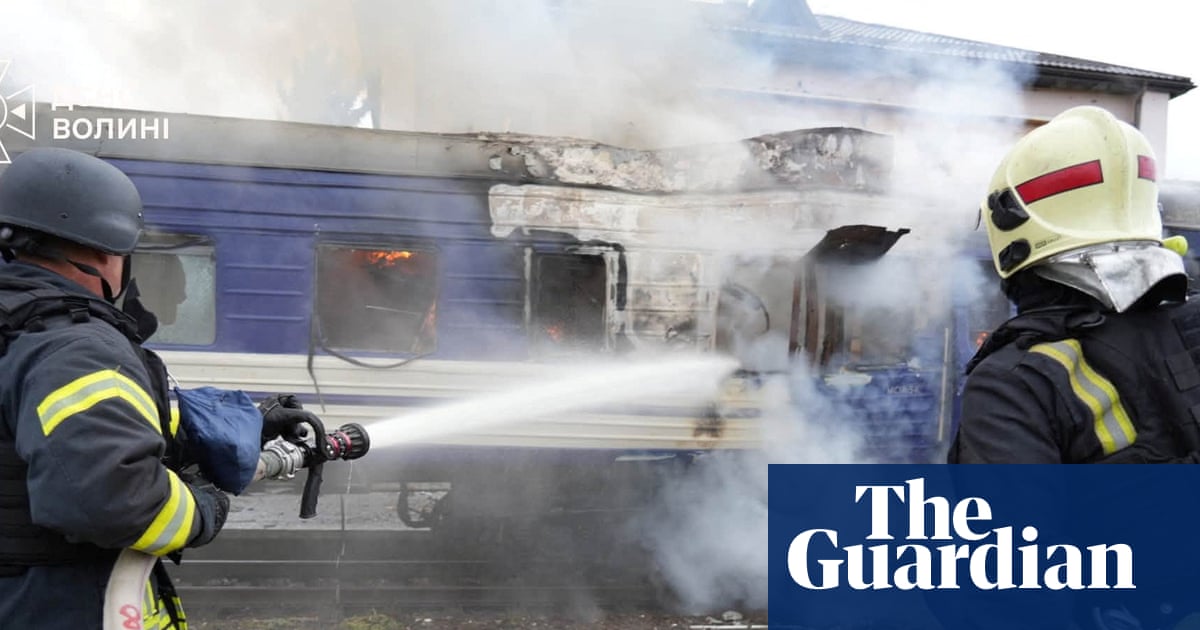 Photo: The Guardian
Why a train near the Polish border is different
This was a passenger service on a published international timetable, not a freight movement on a military supply line. It was travelling toward a NATO country and was hit close to the frontier with it.
Proximity is the issue. Western Ukraine sits a short flight from alliance airspace, and a weapon landing near that line forces every member government to decide whether this was spill-over from a war next door or a strike on the alliance itself.
Two treaty provisions answer that question, and they are routinely confused with each other. Both are described on NATO’s collective defence page, which is the primary source for the rows below.
| Article 4 | Article 5 | |
|---|---|---|
| What the clause does | Allies consult when a member’s territorial integrity, political independence or security is threatened | An armed attack against one ally is treated as an attack against all |
| Who triggers it | Any single member, on its own initiative | The alliance, after determining that an armed attack occurred |
| Record of use, per NATO | Consultations have been convened at members’ request | Invoked once, after the 11 September 2001 attacks |
Article 4 is a meeting, not a mobilisation. It is the step a government takes when it wants the other allies in the room, and on the facts as currently reported it is the far likelier of the two.
What an escalation contract would actually pay on
For readers who have not traded these: prediction markets list geopolitical events as plain yes-or-no contracts. A typical one asks whether NATO invokes Article 4 before a set date, or whether a Russian strike hits alliance territory this calendar year. A share pays one dollar if the answer is yes and nothing if it is no, so a share priced at 12 cents is the crowd saying the chance is roughly 12 in 100. If you would rather see the conversion both ways, our odds converter takes a price and returns the implied probability and the payout.
We are not quoting a live price here, because the source material behind this piece does not contain one. A stale number on a breaking story is worse than no number at all.
What you can check without a quote is the wording. Escalation contracts live and die on resolution criteria: which body has to make the announcement, whether a request for consultations counts as an invocation, whether an unconfirmed strike in a border region resolves yes, and what the deadline is. We worked through exactly this problem after the earlier NATO incursion scare, and the traders who read the rules page did better than the ones who read the headline.
The second thing to check is depth, and here it is worth being explicit that this is an illustration rather than a claim about any specific market. Consider a thin overnight book in which one modest order is the only thing standing between 8 cents and 20 cents. That print would then travel through screenshots and aggregators looking exactly like information.
Drone stories reverse fast
The region has a recent reminder of how quickly the first version of a drone story can be wrong. In Lithuania, what looked like Russian drones and drew NATO jets into the air turned out to be a flock of birds. Nobody was hurt and no treaty clause was touched.
This case is different in kind: a train was hit, and a named outlet is reporting a Russian drone as the cause. But the shape of the first 24 hours is the same. Confirmation arrives slowly, prices arrive instantly, and the gap between them is where the bad trades get made.
 Photo: The Guardian
The thresholds that will decide how this resolves
If a contract on this event exists or appears, these are the specific tests in its rules page, and they are not the same as the four open facts above:
- Who has to say it. A resolution that requires a NATO announcement is not satisfied by a Polish media report that consultations were requested. Look for the named source in the criteria, not the spirit of the market.
- Whose soil. Contracts keyed to a strike on alliance territory require the impact to land on NATO soil. A hit inside Ukraine near the border does not qualify, however close the kilometre count.
- Which date binds. An invocation inside the window pays; the same event one day after the deadline pays nothing. On a story that may take a week to be officially characterised, the deadline is doing more work than the headline.
Until an official response lands, the honest position on this story is that the confirmed facts support a serious incident and nothing more specific than that.
FAQ
Were there casualties on the Kyiv-Warsaw train?
The material available to us does not include a casualty figure. The Guardian reported that a Russian drone hit the train, with no detail on injuries or deaths in the account we have. Treat any specific number circulating as unconfirmed until the operator or Ukrainian officials state one.
What is the difference between NATO Article 4 and Article 5?
Article 4 lets any single member call consultations when its territorial integrity, political independence or security is threatened; it produces a meeting, not a military response. Article 5 treats an armed attack against one ally as an attack against all, and NATO says it has been invoked once, after the 11 September 2001 attacks.
How do prediction markets price an event like this?
They are written as yes-or-no contracts: a share pays one dollar if the event happens by the deadline and nothing if it does not, so the price is the implied probability. What matters most is the resolution criteria, which specify whose announcement counts and where the strike must land.