Lithuania Drone Sighting Was a Flock of Birds, NATO Jets
Lithuania closed Vilnius airport and NATO summoned jets over a possible drone on Sept. 13, 2026. Officials said it was a flock of birds, Reuters reports.
Lithuania closed Vilnius airport and NATO summoned fighter jets on Sept. 13, 2026, after a possible drone was reported in the country’s airspace. The object turned out to be a flock of birds, Lithuanian officials said, according to Reuters.
The two facts arrived in the wrong order. The scramble came first; the punchline came later, after an airport had been shut and allied aircraft had been put in the air over a NATO member state that borders Russia’s Kaliningrad exclave and Belarus.
What has been established — and what has not
Reuters reported the airport closure, the NATO response to a possible drone, and the Lithuanian officials’ subsequent identification of the object as birds. That identification is a government attribution. No radar trace has been published that would independently confirm it.
Several details have not been established publicly: how many aircraft were involved, which base they flew from, how long Vilnius airport stayed closed, how the object was first detected, and what species was identified. The airport publishes its own operational notices at Vilnius Airport.
Why a flock of birds can look like a drone
NATO keeps allied fighters on a standing quick-reaction rotation in the Baltic states under its air-policing mission, which is why a scramble can be ordered in minutes rather than hours (background summary). Minutes are not much time to decide what a contact is.
Bird flocks have been a known source of false radar returns for as long as radar has existed. A dense flock can present to a sensor as a single small, slow-moving contact rather than dozens of individual animals. Automated systems flag contacts by size, speed and altitude, not by intent, and a low, slow, small track over a country bracing for drones is exactly the profile that gets escalated rather than dismissed.
The asymmetry explains the response. Closing an airport and launching fighters is expensive and embarrassing if the target is a bird; missing a real drone is catastrophic. Air-defense staffs are built to absorb the first cost.
 Photo: FluxrBot illustration
What a scare like this does to an incursion contract
No prices for any market tied to this sighting appear in the Reuters report, and we cannot point to a specific platform or resolution question covering it. So the rest of this section describes how contracts on this theme generally behave, not how one traded on Sept. 13.
The mechanics, for readers who have never traded one: a binary contract pays $1 if a defined thing happens and $0 if it does not, and it trades at a price between those two. Say a contract on an incursion trades at 8 cents. The market is saying 8%. Buy at 8 cents and you collect 92 cents of profit if it resolves yes, and lose your 8 cents if it resolves no. Our odds converter turns any price into a percentage in one step, and we have a short field guide to reading Polymarket prices as probabilities.
The structural point is the one that matters here: a contract that pays on “a drone enters NATO airspace” does not pay on “a drone is reported.” It pays on the resolved fact. A trader who buys the headline is holding an instrument whose trigger has just been publicly ruled out.
| Stage of the story | What is publicly established | What a binary on an incursion is pricing |
|---|---|---|
| Possible drone reported, airport closed | Closure and jet response, both confirmed by officials | The chance a real incursion is under way — plus the chance the headline gets read that way |
| Officials say it was birds | A government attribution, with no published radar data | The chance the contract resolves “no incursion” — typically repriced within minutes |
| Days later | Nothing further unless data is released | Liquidity thins; the price drifts toward settlement |
Those timings are how such contracts are expected to behave on a fast correction, not a record of trades in this case. What makes the sequence useful anyway is that it leaves a public trace: the alert gets a price, the correction gets a price, and anyone can see how confident people were at each point.
What resolves, and who decides
Resolution language matters more than the news cycle. Contracts on incursions typically name the sources that count — a government statement, an alliance communiqué, designated press agencies — and specify whether a reported sighting qualifies or only a confirmed one. Under most formulations, an object identified by national officials as birds is a confirmed non-event, and a contract paying on a drone entering airspace settles no.
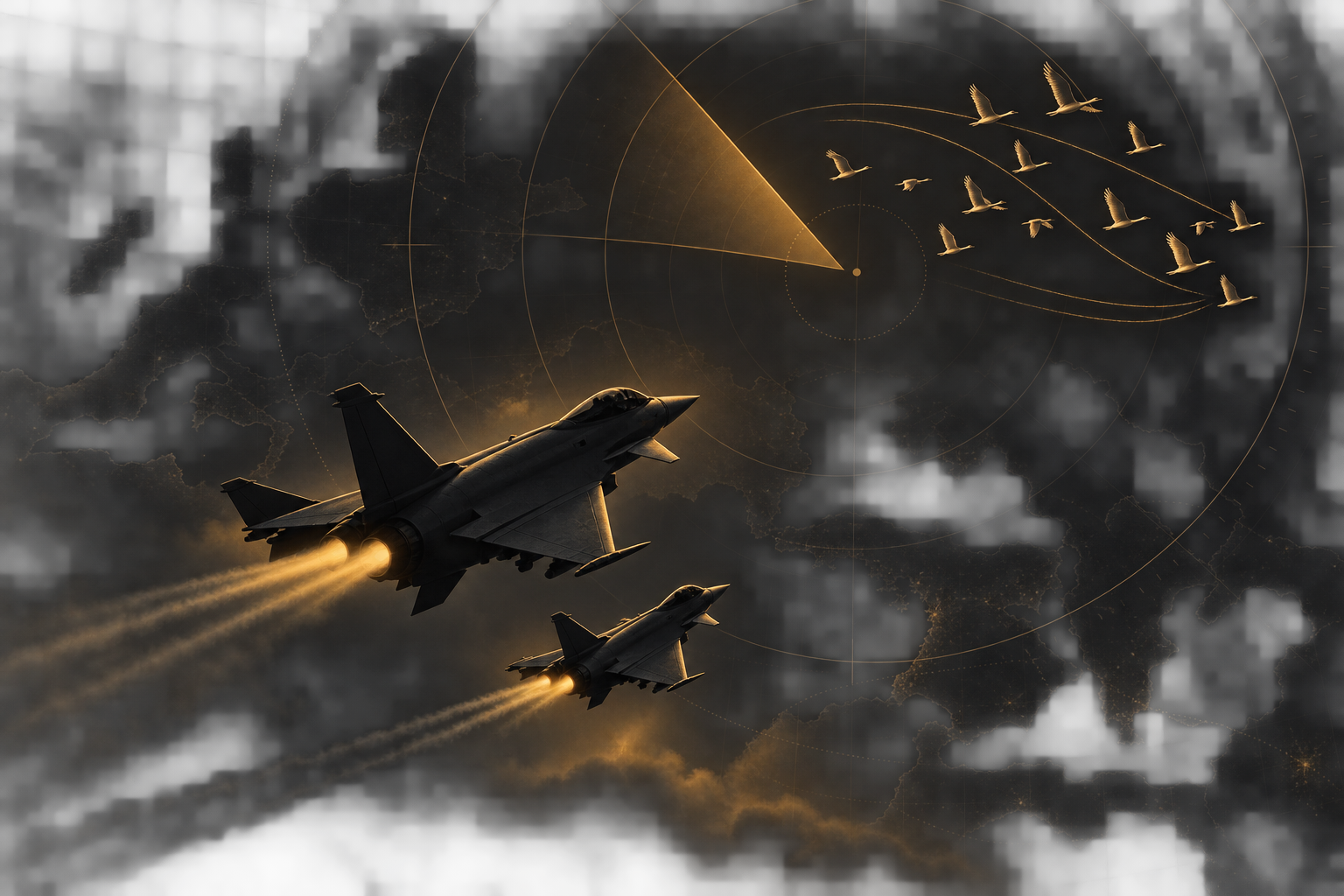 Photo: FluxrBot illustration
The consequence traders carry forward
One bird scare tells you nothing about the next drone. What it shows is that the detection-and-response posture on NATO’s eastern flank fires early, and that a single unverified contact can close an international airport and put allied fighters in the air before anyone knows what they are looking at.
For markets, the consequence is about frequency, not about this event. Alerts on this front arrive often and mostly resolve as nothing; genuine incursions are rare and consequential. That distribution punishes anyone who buys every alert at the same price, and it rewards traders who read resolution criteria before they read headlines. We walked through how incursion-odds contracts behaved after an earlier intelligence-driven spike in Reading Incursion Odds After the NATO Intel Leak.
Reuters has not reported a follow-up investigation into the Sept. 13 sighting, and no radar data has been published that would settle what crossed the sky above Vilnius.
FAQ
Was the drone over Lithuania real?
Lithuanian officials said the object reported on Sept. 13, 2026 was a flock of birds, according to Reuters. No radar data has been published that would independently confirm that identification.
Did NATO really scramble jets over birds?
Reuters reported that Vilnius airport was closed and NATO summoned jets in response to a possible drone. The birds identification came from Lithuanian officials afterward, not before the response.
Why do birds set off air-defense systems?
A dense flock can appear to radar as one small, slow-moving contact instead of dozens of animals. Detection systems flag contacts by size, speed and altitude, so a low, slow track gets escalated rather than dismissed.
Can you trade prediction markets on drone incursions?
Binary contracts on escalation themes pay $1 if a defined event happens and $0 if it does not. They price the resolved fact rather than the reported sighting, so an alert later ruled out by officials typically settles no.