US Confirms Space Weapons Deployed in Orbit
The Pentagon acknowledged for the first time it has offensive weapons in orbit, sparking warnings from China of an arms race in space.

The United States confirmed Monday it has deployed a space weapon in Earth’s orbit — the first time the Pentagon has publicly acknowledged offensive military capabilities in space.
Air Force Secretary Troy Meink announced the deployment at the Air, Space and Cyber Conference, calling the “on orbit” weapon necessary to protect US forces against hostile threats. He did not specify what the weapon does or when it was launched.
China responded Tuesday by warning against an “arms race” in space. “We urge the US side to stop expanding its military capabilities and preparing for war in outer space,” a foreign ministry spokesman told AFP, according to the BBC.
What the Weapon Might Be
The Pentagon has released almost no technical details. A Space Force spokesperson said the system can “disrupt, degrade and even destroy” adversary capabilities using “kinetic and non-kinetic means” — military jargon that covers everything from jamming signals to physical collisions.
Dr. Bleddyn Bowen of the Royal United Services Institute told the BBC the weapon is most likely “some kind of electronic warfare or radio jamming platform” that disrupts communications — technology that already exists on Earth. A less likely option would be a kinetic vehicle that rams satellites, though that would create debris fields and is generally avoided.
 Photo: BBC
The US Space Force defines “space control” as contesting and controlling the space domain through offensive and defensive means, employed at the direction of combatant commands.
Why Now
Senior military leaders have said for years they planned to expand space capabilities in response to Russian and Chinese programs designed to attack US satellites in a future conflict. The Space Force — launched in 2019 as the first new military branch in over 70 years — exists to protect American assets in orbit, including hundreds of satellites used for communication and surveillance.
Last year President Donald Trump signed an executive order making clear the Space Force’s role extends beyond defense to offensive operations. The Trump administration has also said space-based interceptors are a key part of its “Golden Dome” missile defense system.
In February, two Russian satellites were revealed to have intercepted communications from at least a dozen European satellites since Russia’s invasion of Ukraine in 2022, potentially allowing Russian intelligence to read sensitive data or take control. In 2024, the US said Russia had launched a satellite believed capable of attacking other spacecraft; Russia did not comment publicly.
The Space Force says China “develops and operates space and counterspace capabilities as part of a military modernization strategy,” while Russia “views space as a warfighting domain and believes space supremacy will be a decisive factor in future conflicts.”
What the Treaty Allows
A 1967 treaty banned weapons of mass destruction in orbit but left the door open for other systems. The US, Russia, and China have all pursued capabilities outside the treaty’s scope, including anti-satellite weapons that target rivals’ communications, navigation, and surveillance infrastructure.
The US confirmation follows years of classified development. While the Pentagon has discussed space weapons in budgets and strategy documents, this is the first time it has said one is operational in orbit.
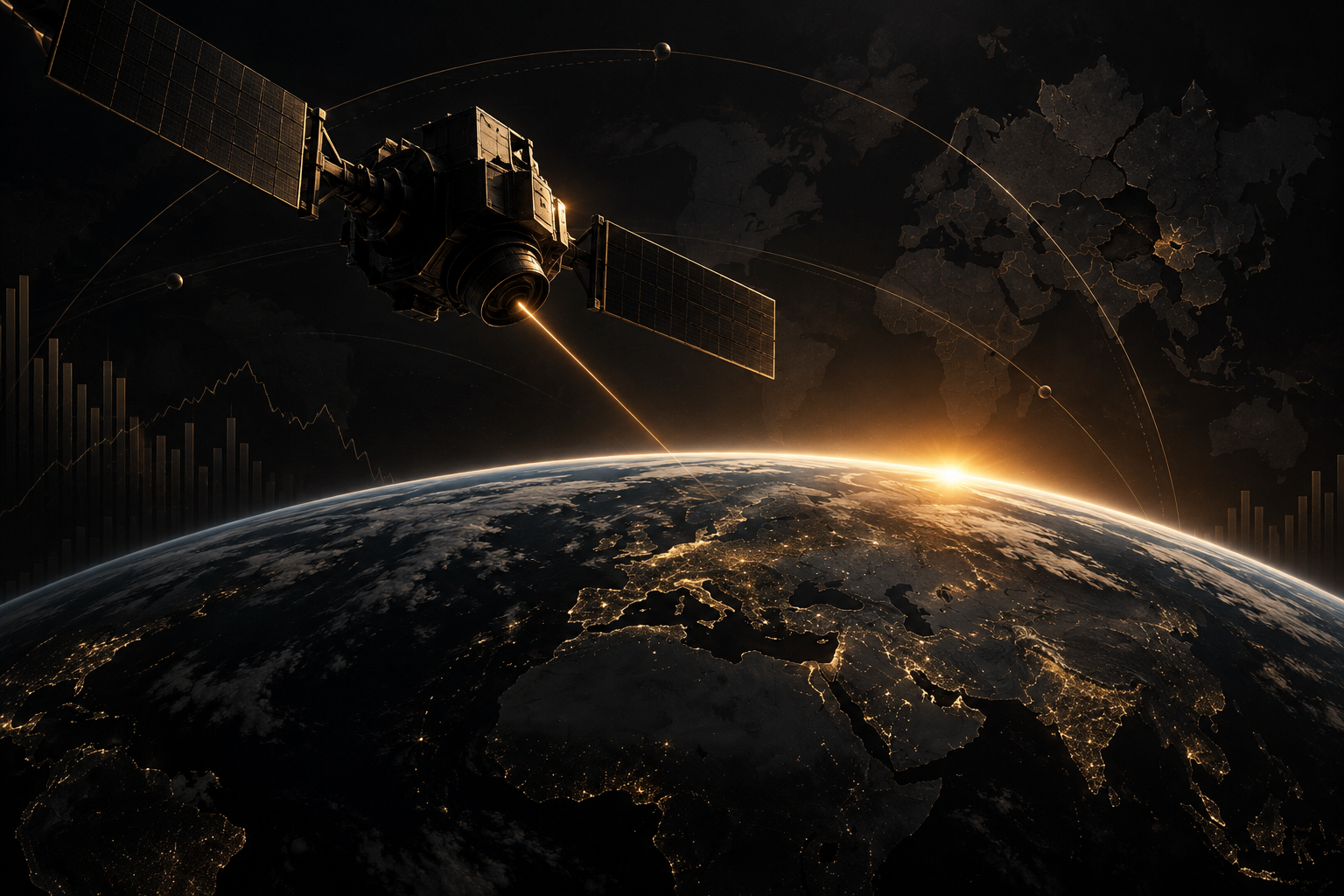 Photo: FluxrBot illustration
What Prediction Markets Could Price
No major prediction platform currently runs a contract on the next space-weapon deployment or on whether China or Russia will respond in kind. If such markets existed, they would likely track defense-contractor budgets tied to space programs — capital-intensive, slow to field, and politically visible — alongside geopolitical escalation probabilities.
The public confirmation gives a concrete baseline that did not exist before: the US now has at least one offensive system in orbit, and it said so out loud. That fact alone could anchor future contracts on military space activity, should platforms choose to list them.
FAQ
What kind of space weapon did the US deploy?
The Pentagon has not disclosed technical details. Experts believe it is most likely an electronic warfare or radio jamming platform that disrupts communications, similar to technology already used on Earth. A less likely option is a kinetic vehicle that physically rams satellites, though that would create dangerous debris fields.
Are space weapons legal under international law?
A 1967 treaty banned weapons of mass destruction in orbit but allows other offensive systems. The US, Russia, and China have all developed anti-satellite capabilities outside the treaty’s scope, targeting rivals’ communications and navigation infrastructure.
Why did the US deploy a space weapon now?
Senior military leaders cite Russian and Chinese programs designed to attack US satellites in a future conflict. Russia has intercepted European satellite communications since 2022, and in 2024 launched a satellite the US believes is capable of attacking other spacecraft.